![[Search]](/static/images/search.gif)
![[A-Z Index]](/static/images/az.gif)
![[Contact]](/static/images/contact.gif)
![[University of Cambridge]](/static/images/identifier2.gif)
![[Talks.cam]](/static/images/talkslogosmall.gif)


 Friday 16 March 2018, 15:00-16:00

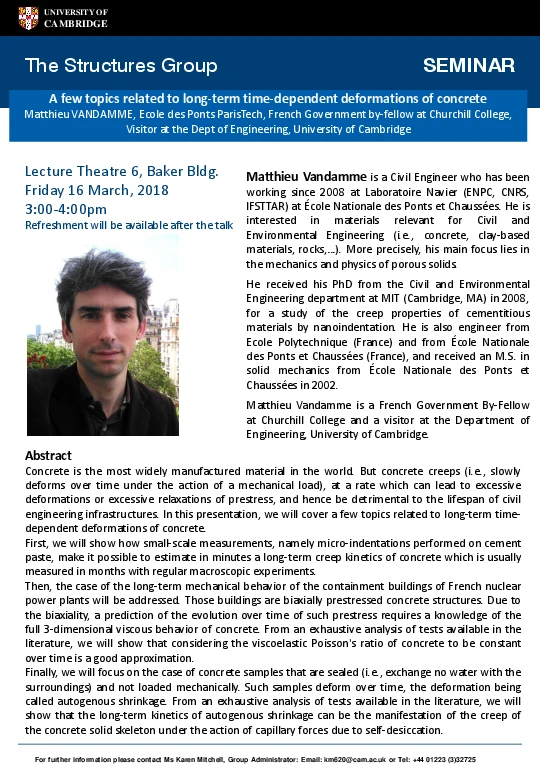
A few topics related to long-term time-dependent deformations of concrete
- 👤 Speaker: Dr Matthieu Vandamme, École Nationale des Ponts et Chaussées
- 📅 Date & Time: Friday 16 March 2018, 15:00 - 16:00
- 📍 Venue: Cambridge University Engineering Department, LT6
Abstract
Concrete is the most widely manufactured material in the world. But concrete creeps (i.e., slowly deforms over time under the action of a mechanical load), at a rate which can lead to excessive deformations or excessive relaxations of prestress, and hence be detrimental to the lifespan of civil engineering infrastructures. In this presentation, we will cover a few topics related to long-term time-dependent deformations of concrete. First, we will show how small-scale measurements, namely micro-indentations performed on cement paste, make it possible to estimate in minutes a long-term creep kinetics of concrete which is usually measured in months with regular macroscopic experiments. Then, the case of the long-term mechanical behavior of the containment buildings of French nuclear power plants will be addressed. Those buildings are biaxially prestressed concrete structures. Due to the biaxiality, a prediction of the evolution over time of such prestress requires a knowledge of the full 3-dimensional viscous behavior of concrete. From an exhaustive analysis of tests available in the literature, we will show that considering the viscoelastic Poisson’s ratio of concrete to be constant over time is a good approximation. Finally, we will focus on the case of concrete samples that are sealed (i.e., exchange no water with the surroundings) and not loaded mechanically. Such samples deform over time, the deformation being called autogenous shrinkage. From an exhaustive analysis of tests available in the literature, we will show that the long-term kinetics of autogenous shrinkage can be the manifestation of the creep of the concrete solid skeleton under the action of capillary forces due to self-desiccation.
Matthieu Vandamme is a Civil Engineer who has been working since 2008 at Laboratoire Navier (ENPC, CNRS , IFSTTAR) at École Nationale des Ponts et Chaussées. He is interested in materials relevant for Civil and Environmental Engineering (i.e., concrete, clay-based materials, rocks,…). More precisely, his main focus lies in the mechanics and physics of porous solids. He received his PhD from the Civil and Environmental Engineering department at MIT (Cambridge, MA) in 2008, for a study of the creep properties of cementitious materials by nanoindentation. He is also engineer from Ecole Polytechnique (France) and from École Nationale des Ponts et Chaussées (France), and received an M.S. in solid mechanics from École Nationale des Ponts et Chaussées in 2002. Matthieu Vandamme is a French Government By-Fellow at Churchill College and a visitor at the Department of Engineering, University of Cambridge.
Series This talk is part of the Engineering Department Structures Research Seminars series.
Included in Lists
- All Talks (aka the CURE list)
- bld31
- Cambridge talks
- Cambridge University Engineering Department, LT6
- Cambridge University Engineering Department Talks
- Centre for Smart Infrastructure & Construction
- Civil Engineering Talks
- Computational Continuum Mechanics Group Seminars
- Engineering Department Structures Research Seminars
- Featured lists
- Interested Talks
- School of Technology
- Trust & Technology Initiative - interesting events
- yk449
Note: Ex-directory lists are not shown.