![[Search]](/static/images/search.gif)
![[A-Z Index]](/static/images/az.gif)
![[Contact]](/static/images/contact.gif)
![[University of Cambridge]](/static/images/identifier2.gif)
![[Talks.cam]](/static/images/talkslogosmall.gif)


 Friday 02 November 2018, 12:00-13:00

Multi-agent paradoxes in quantum theory & Discovering physical principles with neural networks(2 mini talks)
- 👤 Speaker: Nuriya Nurgalieva & Lídia del Río
- 📅 Date & Time: Friday 02 November 2018, 12:00 - 13:00
- 📍 Venue: MR21, Centre for Mathematical Sciences, Wilberforce Road, Cambridge
Abstract
Inadequacy of multi-agent logic in quantum settings
Nuriya Nurgalieva (ETH Zurich), 25min
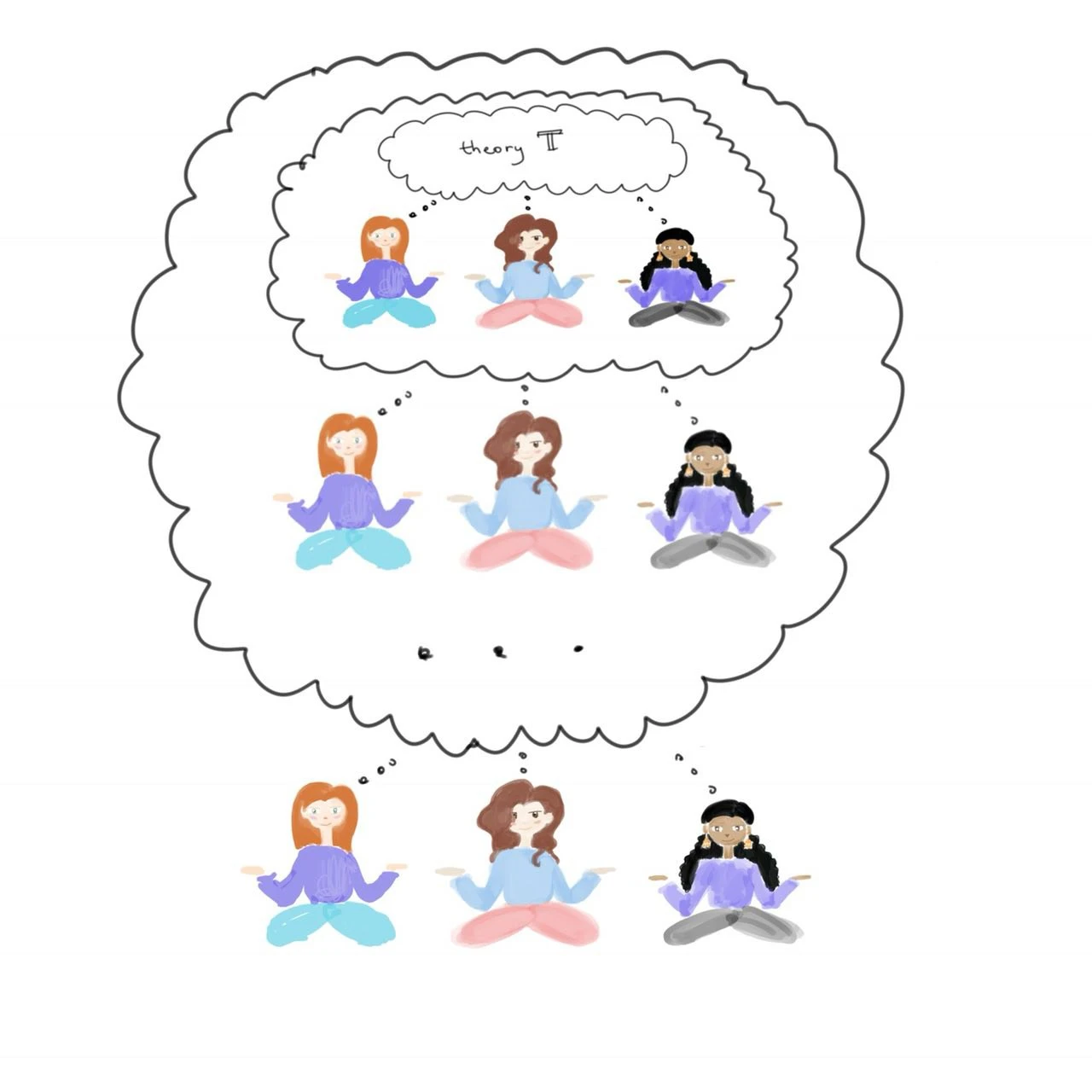
We probe basic logical principles in multi-agent quantum settings, where parties are equipped with quantum memories, like in a network of quantum computers. A good testing ground is provided by Frauchiger-Renner thought experiment, where agents argue about the outcomes of each other’s measurements. Using this example, we show that classical logic cannot be applied to general settings where quantum experiments are conducted, a result that impacts quantum cryptography and communication theory. We propose ways to weaken logical axioms as to make them robust under quantum settings, and conjecture that doing so would require parties to keep exponentially large memories. Finally, we find a missing assumption in the Frauchiger-Renner result.
Based on https://arxiv.org/abs/1804.01106 joint with Lídia del Rio
Discovering physical concepts with neural networks
Lídia del Rio (ETH Zurich), 25min
The formalism of quantum physics is built upon that of classical mechanics. In principle, considering only experimental data without prior knowledge could lead to an alternative quantum formalism without conceptual issues like the measurement problem. As a first step towards finding such an alternative, we introduce a neural network architecture that models the physical reasoning process and can be used to extract physical concepts from experimental data in an unbiased way. We apply the neural network to a variety of simple physical examples in classical and quantum mechanics, like damped pendulums, two-particle collisions, and qubits. The network finds the physically relevant parameters, exploits conservation laws to make predictions, and can be used to gain conceptual insights. For example, given a time series of the positions of the Sun and Mars as observed from Earth, the network discovers the heliocentric model of the solar system – that is, it encodes the data into the angles of the two planets as seen from the Sun.
Based on http://arxiv.org/abs/1807.10300 joint with Raban Iten, Tony Metger, Henrik Wilming and Renato Renner
Series This talk is part of the CQIF Seminar series.
Included in Lists
- All CMS events
- bld31
- CMS Events
- CQIF Seminar
- DAMTP info aggregator
- Hanchen DaDaDash
- Interested Talks
- MR21, Centre for Mathematical Sciences, Wilberforce Road, Cambridge
Note: Ex-directory lists are not shown.