![[Search]](/static/images/search.gif)
![[A-Z Index]](/static/images/az.gif)
![[Contact]](/static/images/contact.gif)
![[University of Cambridge]](/static/images/identifier2.gif)
![[Talks.cam]](/static/images/talkslogosmall.gif)

 Professor Rebecca Kilner, Department of Zoology 18.00 - 19.00
  Monday 24 February 2020, 18:00-19:00

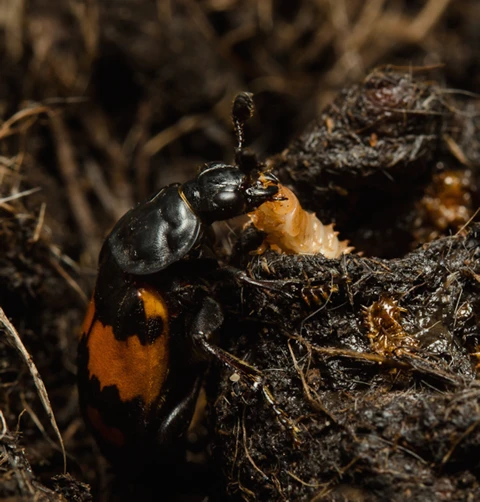
Simpson's question: How does behaviour determine evolution?
- 👤 Speaker: Professor Rebecca Kilner, Department of Zoology 18.00 - 19.00
- 📅 Date & Time: Monday 24 February 2020, 18:00 - 19:00
- 📍 Venue: Bristol-Myers Squibb Lecture Theatre, Department of Chemistry
Abstract
For more than 50 years, the scientific study of animal behaviour has been defined by Tinbergen’s Four Questions. Two of his questions consider the connection between evolution and animal behaviour. They ask: how is behaviour is adaptive, and what is its evolutionary history?
Five years before Tinbergen asked his Four Questions, G. G. Simpson posed a question of his own. Simpson was a palaeontologist and one of the architects of the Modern Synthesis (the body of work in the first half of the 20th century that married a Darwinian view of natural selection with genetic analyses of variation and inheritance). Simpson had successfully introduced the concepts of the Modern Synthesis into palaeontology and set his sights on achieving the same for animal behaviour. His question gets straight to the heart of the matter: How does behaviour evolve and how does it then determine subsequent evolution?
Yet Simpson’s question has been overshadowed by Tinbergen’s Questions, and largely forgotten. Far more work has considered how behaviour is adaptive than how behaviour contributes to evolution. In this talk, I will explain why the answers to Simpson’s Question matter now, and describe some experiments that explain exactly how behaviour can affect the course of evolution.
Our research focuses on the burying beetle (or sexton beetle), an insect that is abundant in the woodlands surrounding Cambridge and that has a remarkable natural history. It is named for its habit of burying the dead, and tending the graveyard. It locates a small corpse to breed upon, such as a mouse or a songbird, shaves off the fur or feathers, rolls the flesh into a ball and then inters it in a shallow grave where it becomes an edible nest for its larvae. The parent beetles then tend to their young, by feeding them and defending them from attack. The natural history of these animals lends itself to experimental evolution, and lets us test directly how behaviour determines evolution.
Series This talk is part of the Cambridge Philosophical Society series.
Included in Lists
- All Talks (aka the CURE list)
- baz21 science lists
- Biomimetic manufacturing and sustainability
- Bristol-Myers Squibb Lecture Theatre, Department of Chemistry
- Cambridge Philosophical Society
- Centre for Health Leadership and Enterprise
- Chris Davis' list
- custom
- Featured lists
- Featured talks
- Guy Emerson's list
- ld636
- Major Public Lectures in Cambridge
- Martin's interesting talks
- mig40's list
- Neurons, Fake News, DNA and your iPhone: The Mathematics of Information
- personal list
- PMRFPS's
Note: Ex-directory lists are not shown.