![[Search]](/static/images/search.gif)
![[A-Z Index]](/static/images/az.gif)
![[Contact]](/static/images/contact.gif)
![[University of Cambridge]](/static/images/identifier2.gif)
![[Talks.cam]](/static/images/talkslogosmall.gif)


 Thursday 20 February 2020, 13:45-14:45

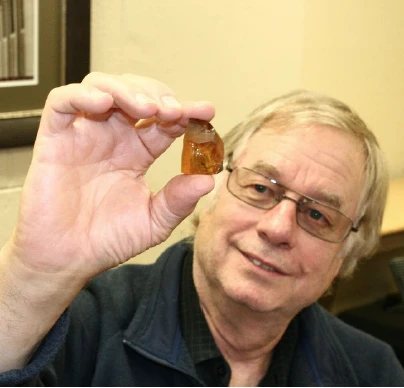
Challenging Paradigms of Glass Formation: The Kauzmann Paradox and Diverging Time-Scales
- 👤 Speaker: Professor Gregory B. McKenna, Department of Chemical Engineering, Texas Tech University 🔗 Website
- 📅 Date & Time: Thursday 20 February 2020, 13:45 - 14:45
- 📍 Venue: Goldsmiths' Lecture Room 1, Department of Materials Science & Metallurgy, 27 Charles Babbage Road, CB3 0FS
Abstract
There are two important “signatures” related to glass formation. The first is the apparent entropy catastrophe that occurs at the Kauzmann temperature TK where the extrapolated entropy seems to go below that of the crystal. A related phenomenon is that the dynamics (relaxation times) of glass-forming systems seem to extrapolate to a finite temperature divergence at the so-called VFT temperature TVFT , which is often found to be close to TK. Testing the equilibrium response near to these temperatures has become a major challenge in glass physics. To tackle this problem, we are using materials with extremely low fictive temperature TF relative to Tg, entering an unexplored region of the glassy state. First, we used of a 20 million year old amber with TF ∼ 43.6 K below Tg. We found that the relaxation times deviated strongly from the expected VFT or WLF -behaviors turning towards an Arrhenius-response, albeit with a high activation energy. Also, we built on the ultra-stable glasses ideas exploited by Ediger and co-workers and developed a vapor deposition procedure to make an amorphous Teflon material with TF ∼55 K below Tg and close to the putative TK. Our results challenge the view that there is an “ideal” glass transition as posited by multiple theories and commonly considered an important aspect of glass-formation and glassy behavior. In addition, we have examined the thermodynamics of the problem by using an athermal mixture of a poly(-methyl styrene) with its own pentamer and show that in this system the equilibrium entropies continue smoothly without evidence of a second order transition to at least 180 K below the Kauzmann temperature. Such results are consistent with there not being an “ideal” glass transition and demand reconsideration of theories that use or predict such a thermodynamic point in glass-forming systems.
Series This talk is part of the Microstructural Kinetics Group - Department of Materials Science & Metallurgy series.
Included in Lists
- Goldsmiths' Lecture Room 1, Department of Materials Science & Metallurgy, 27 Charles Babbage Road, CB3 0FS
- Microstructural Kinetics Group - Department of Materials Science & Metallurgy
Note: Ex-directory lists are not shown.