![[Search]](/static/images/search.gif)
![[A-Z Index]](/static/images/az.gif)
![[Contact]](/static/images/contact.gif)
![[University of Cambridge]](/static/images/identifier2.gif)
![[Talks.cam]](/static/images/talkslogosmall.gif)

 Dr Kathelijne Koops, University of Cambridge
 Thursday 26 November 2020, 16:00-17:30

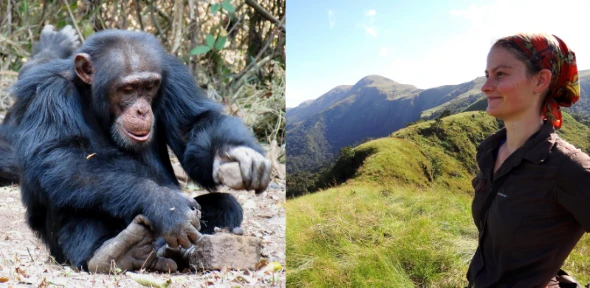
Of Apes and Tools: Insights into the Evolution of Technology
- 👤 Speaker: Dr Kathelijne Koops, University of Cambridge 🔗 Website
- 📅 Date & Time: Thursday 26 November 2020, 16:00 - 17:30
- 📍 Venue: Zoom
Abstract
Abstract: Complex technology is a defining feature of modern humans. Our technological innovations have reshaped our planet and changed the impact of evolutionary forces upon our lives. Despite the enormous significance of human technology, the evolutionary origin of this complex use of tools is not well understood. Comparative research is crucial to determining the evolutionary forces which prompted differences in technological skill to emerge and diverge among humans and other species. In this talk, Kathelijne will discuss her research that investigates the drivers of tool use in our ape cousins. First, she will introduce you to research at her chimpanzee study site in the Nimba Mountains, Guinea. Findings from Nimba highlight a key role for the environment in explaining tool use by chimpanzees. Next, she will discuss her comparative work on the two species of apes most closely related to humans, the (tool-using) chimpanzee and the (non tool-using) bonobo. By comparing the material cultures of these two ape species she discovered that the intrinsic motivation to interact with objects is critical in explaining the species difference in tool use. Lastly, she will introduce you to ongoing research which investigates the drivers of tool use across all the African apes and humans.
Dr Kathelijne Koops is Lecturer in Primatology in the Department of Archaeology, University of Cambridge.
Please join us on Zoom for this presentation.
Please register via the following link:
https://cam-ac-uk.zoom.us/meeting/register/tJIucemorTIoEtzeW9wDGDhOSOaHNYJo8SQ9
Series This talk is part of the Department of Archaeology - Garrod seminar series series.
Included in Lists
Note: Ex-directory lists are not shown.