![[Search]](/static/images/search.gif)
![[A-Z Index]](/static/images/az.gif)
![[Contact]](/static/images/contact.gif)
![[University of Cambridge]](/static/images/identifier2.gif)
![[Talks.cam]](/static/images/talkslogosmall.gif)

 Fernando Caballero, University of California Santa Barbara
 Tuesday 18 May 2021, 16:00-17:00

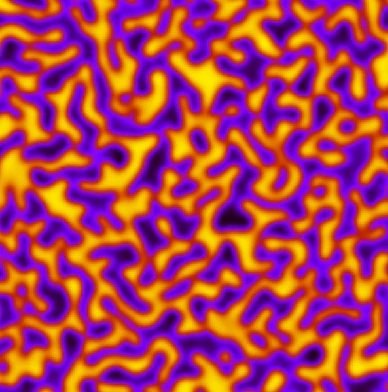
Critical properties of active phase-separation and entropy production.
- 👤 Speaker: Fernando Caballero, University of California Santa Barbara
- 📅 Date & Time: Tuesday 18 May 2021, 16:00 - 17:00
- 📍 Venue: via zoom, meeting ID 940-1803-7756
Abstract
UNUSUAL TIME (4pm)!
Zoom link: https://maths-cam-ac-uk.zoom.us/j/94018037756
The critical properties of active phase separation have been studied numerically, finding Ising-like transitions between uniform and phase separated states, relegating their universal behaviour to that of a passive system. There are, though, transitions to other microphase separated phases which have not been studied from the point of view of their critical properties in depth, specially numerically. This talk will review some analytical results about all these transitions and their differences. The first half of the talk will review a minimal extension of Model B, typically used to model diffusive binary phase separation, that breaks time reversal symmetry. We will see that this simple continuum theory displays these different phases seen in particle simulations and some experimental systems, and that a standard Renormalization Group analysis properly captures the Ising transition, as well as new transitions into a strong coupling regime, producing a phase diagram that matches one found numerically. The second half of the talk will introduce the entropy production for this continuum model, and we will see some more recent result about its critical behaviour, applying a similar scaling anaysis to it. The result, counterintuitive at first, is that the entropy production per correlation volume at the Ising transition stays constant at mean field level, and can potentially diverge at the critical point. This is surprising since at that critical point all active parameters of the theory are irrelevant from the scaling perspective, so its behaviour is equilibrium-like at large scales, meaning there is no equilibrium observable that we could measure on the system that would differentiate between the active and passive transitions. Since this result comes from evaluating the entropy production operator at an equilibrium critical point, this means that its divergence is a property of the equilibrium Ising transition, only for a quantity that is strictly zero at equilibrium, thus indicating that entropy production propagates to all scales as long as it is non zero, no matter how close to equilibrium the system is.
Series This talk is part of the DAMTP Statistical Physics and Soft Matter Seminar series.
Included in Lists
- All CMS events
- bld31
- DAMTP Statistical Physics and Soft Matter Seminar
- Soft Matter
- via zoom, meeting ID 940-1803-7756
Note: Ex-directory lists are not shown.