![[Search]](/static/images/search.gif)
![[A-Z Index]](/static/images/az.gif)
![[Contact]](/static/images/contact.gif)
![[University of Cambridge]](/static/images/identifier2.gif)
![[Talks.cam]](/static/images/talkslogosmall.gif)


 Thursday 04 November 2021, 13:00-14:00

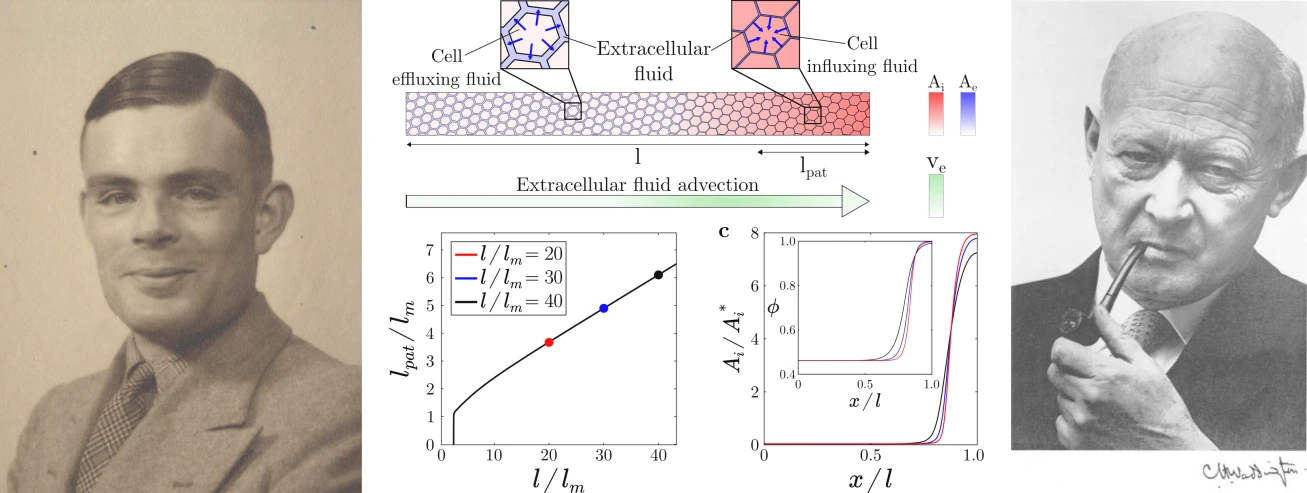
When Turing meets Waddington: Theory of mechanochemical patterning in biphasic biological tissues
- 👤 Speaker: Dr Adrien Hallou, Gurdon Institute & Cavendish Laboratory 🔗 Website
- 📅 Date & Time: Thursday 04 November 2021, 13:00 - 14:00
- 📍 Venue: King Richard Room, Darwin College
Abstract
The starting point of a research project is usually a hypothesis or a model prediction that one would like to confirm or infirm, or maybe an observation that one would like to rationalize with the help of a model. However, the foundation of the research I shall present in my talk, was none of these, but a letter (AMT/D/5, Alan Turing Archive, King’s College Archive Centre, Cambridge) sent by the famous biologist Conrad Waddington to Alan Turing in 1952! In this letter, Waddington thanks Turing for sending a reprint of his seminal paper “The chemical basis of morphogenesis” (Philosophical Transactions of the Royal Society of London, vol. 237, 1952, p. 37-72) and raise several concerns about the applicability of Turing’s reaction-diffusion model to biological developmental systems, questioning its limitation to reproduce some observed behaviours in embryonic development such as pattern scaling with tissue size or the generation of a spatial pattern of discrete cell types. Unfortunately, it seems that this letter remained unanswered, certainly due to the untimely death of Turing. In my talk, I will present a minimal model trying to answer Waddington objections to Turing’s model and which combines tissue mechanics with morphogen turnover and transport to explore new routes to patterning. This active description couples morphogen reaction and diffusion, which impact cell differentiation and tissue mechanics, to a two-phase poroelastic rheology, where one tissue phase consists of a poroelastic cell network and the other one of a permeating extracellular fluid, which provides feedback by actively transporting morphogens. While this model encompasses previous theories approximating tissues to inert monophasic media, such as Turing’s reaction–diffusion model, it overcomes some of their key limitations permitting pattern formation via any two-species biochemical kinetics due to mechanically induced cross diffusion flows. Moreover, I will describe a qualitatively different advection-driven Keller–Segel like instability which allows for the formation of patterns with a single morphogen and whose fundamental mode pattern robustly scales with tissue size. I will discuss the potential relevance of these findings for tissue morphogenesis.
Series This talk is part of the Darwin College Science Seminars series.
Included in Lists
- All Talks (aka the CURE list)
- AUB_Cambridge Seminars
- Centre for Health Leadership and Enterprise
- Chris Davis' list
- custom
- Darwin College Research Talks
- Darwin College Science Seminars
- Darwin Lectures and Seminars
- Guy Emerson's list
- Interested Talks
- King Richard Room, Darwin College
- Neurons, Fake News, DNA and your iPhone: The Mathematics of Information
Note: Ex-directory lists are not shown.