![[Search]](/static/images/search.gif)
![[A-Z Index]](/static/images/az.gif)
![[Contact]](/static/images/contact.gif)
![[University of Cambridge]](/static/images/identifier2.gif)
![[Talks.cam]](/static/images/talkslogosmall.gif)


 Thursday 13 February 2025, 10:00-11:00

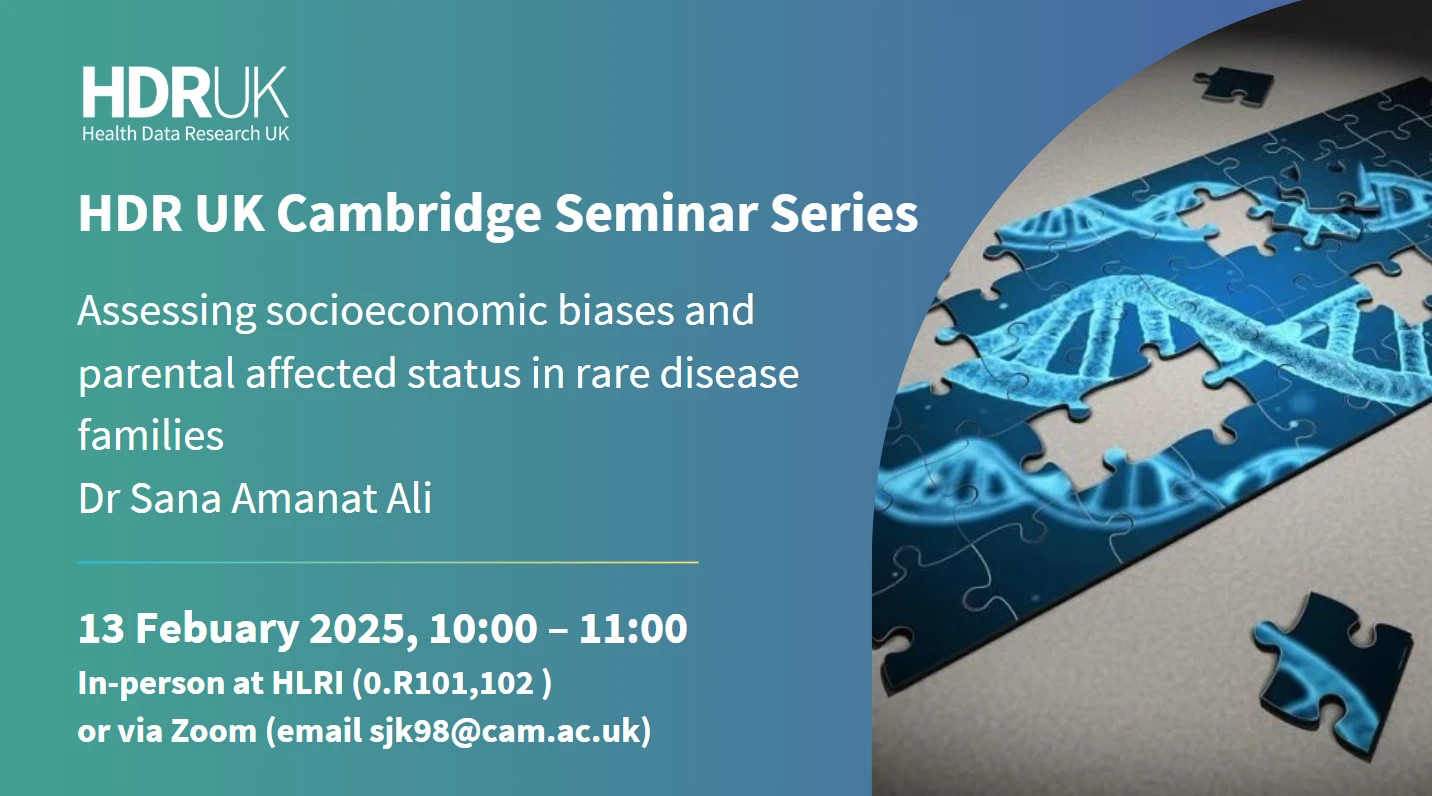
Assessing socioeconomic biases and parental affected status in rare disease families
- 👤 Speaker: Dr Sana Amanat Ali 🔗 Website
- 📅 Date & Time: Thursday 13 February 2025, 10:00 - 11:00
- 📍 Venue: Heart and Lung Research Institute (R.101 and 102) or Virtually via Zoom: https://sanger.zoom.us/j/96837334177?pwd=nf2mHEZTOJ74akQjszz8NqkZbTK5Yx.1
Abstract
Abstract: Many probands recruited to the Rare Disease Arm of the 100,000 Genomes Project (100kGP) and the Deciphering Developmental Disorders (DDD) project (www.ddduk.org) remain undiagnosed with diagnostic rates of 20% and 40% respectively. The linked health record data in the Genomics England 100,000 Genomes project (GEL) provides opportunities to understand the factors influencing diagnostic yield. We assessed the relationship between socioeconomic deprivation and diagnostic status in DDD -like families (identified through similar recruitment criteria to the DDD study) in the 100kGP. We found that diagnostic yield is 20% across all deprivation quintiles involving denovo and inherited pathogenic variants. Current clinical pipelines stratify variants by inheritance status, depending on whether a parent is “affected” or not. If parents are incorrectly labelled as “unaffected”, potentially pathogenic inherited variants are likely to be erroneously discarded. We suspected that the clinical annotations might be missing many truly affected parents. Therefore, we sought to develop a classification model of parental affected status of ‘DDD-like’ families, combining multiple attributes of the linked health record data. This model has good performance in identifying affected parents with an AUC on held-out control data of 0.81. The current model predicts that 27% of parents labelled as “unaffected” may have a clinical phenotype relevant to their child’s condition. Next, we aim to integrate the genetic data to see whether transmission rate of damaging variants differs between parents who are predicted to be affected and unaffected.
Biography: Dr. Sana Amanat is a HDR -UK Postdoctoral Fellow at Wellcome Sanger Institute, Hinxton, working within the Prof. Hurles group. Her research focuses on the linking health record data in rare disease families recruited to the 100,000 genomes project to assess parental affected status and potential socioeconomic biases. She obtained her PhD from the University of Granada, Spain. During her Phd, she analysed exome sequencing of patients with Meniere’s disease and extreme tinnitus phenotype.
Series This talk is part of the HDR UK Cambridge Seminar Series series.
Included in Lists
- HDR UK Cambridge Seminar Series
- Heart and Lung Research Institute (R.101 and 102) or Virtually via Zoom: https://sanger.zoom.us/j/96837334177?pwd=nf2mHEZTOJ74akQjszz8NqkZbTK5Yx.1
- ndk22's list
Note: Ex-directory lists are not shown.