![[Search]](/static/images/search.gif)
![[A-Z Index]](/static/images/az.gif)
![[Contact]](/static/images/contact.gif)
![[University of Cambridge]](/static/images/identifier2.gif)
![[Talks.cam]](/static/images/talkslogosmall.gif)

 Pedram Roushan (Google Quantum AI)
 Thursday 26 February 2026, 16:15-17:15

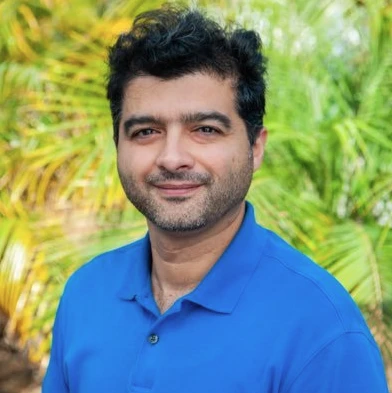
Novel quantum dynamics with superconducting qubits
- 👤 Speaker: Pedram Roushan (Google Quantum AI)
- 📅 Date & Time: Thursday 26 February 2026, 16:15 - 17:15
- 📍 Venue: Ray Dolby Auditorium, Ray Dolby Centre, Cavendish Laboratory, JJ Thomson Avenue, CB3 0US
Abstract
The prevailing view is that quantum phenomena can be leveraged to tackle certain problems beyond the reach of classical approaches. Recent years have witnessed significant progress in this direction; in particular, superconducting qubits have emerged as one of the leading platforms for quantum simulation and computation on Noisy Intermediate-Scale Quantum (NISQ) processors. This progress is exemplified by research ranging from the foundations of quantum mechanics [1] to the non-equilibrium dynamics of elementary excitations [2] and condensed matter physics [3,4]. By utilizing the contextuality of quantum measurements to solve a 2D hidden linear function problem, we demonstrate a quantum advantage through a computational separation for up to 105 qubits on these bounded-resource tasks [1]. Motivated by high-energy physics, we image charge and string dynamics in (2+1)D lattice gauge theories [2], revealing two distinct regimes within the confining phase: a weak-confinement regime with strong transverse string fluctuations and a strong-confinement regime where these fluctuations are suppressed. Turning to condensed matter, we observe novel localization in one- and two-dimensional many-body systems that lack energy diffusion despite being disorder-free and translationally invariant [3]. Additionally, we show that strong disorder in interacting multi-level landscapes can induce superfluidity characterized by long-range phase coherence [4]. Together, these results show that NISQ processors, even without fault tolerance, are powerful tools for probing and advancing our understanding of complex non-equilibrium quantum dynamics.
[1] S. Kumar et al., arxiv.org/abs/2512.02284
[2] Cochran et al., Nature 642, 315–320 (2025)
[3] Gyawali et al., arxiv.org/abs/2410.06557
[4] Ticea et al., arxiv.org/abs/2512.21416
Series This talk is part of the Cavendish Quantum Colloquium series.
Included in Lists
- All Cavendish Laboratory Seminars
- Cavendish Quantum Colloquium
- Centre for Health Leadership and Enterprise
- Featured lists
- few29
- ME Seminar
- Neurons, Fake News, DNA and your iPhone: The Mathematics of Information
- Ray Dolby Auditorium, Ray Dolby Centre, Cavendish Laboratory, JJ Thomson Avenue, CB3 0US
- School of Physical Sciences
- Thin Film Magnetic Talks
Note: Ex-directory lists are not shown.