![[Search]](/static/images/search.gif)
![[A-Z Index]](/static/images/az.gif)
![[Contact]](/static/images/contact.gif)
![[University of Cambridge]](/static/images/identifier2.gif)
![[Talks.cam]](/static/images/talkslogosmall.gif)


 Tuesday 06 January 2026, 16:30-17:30

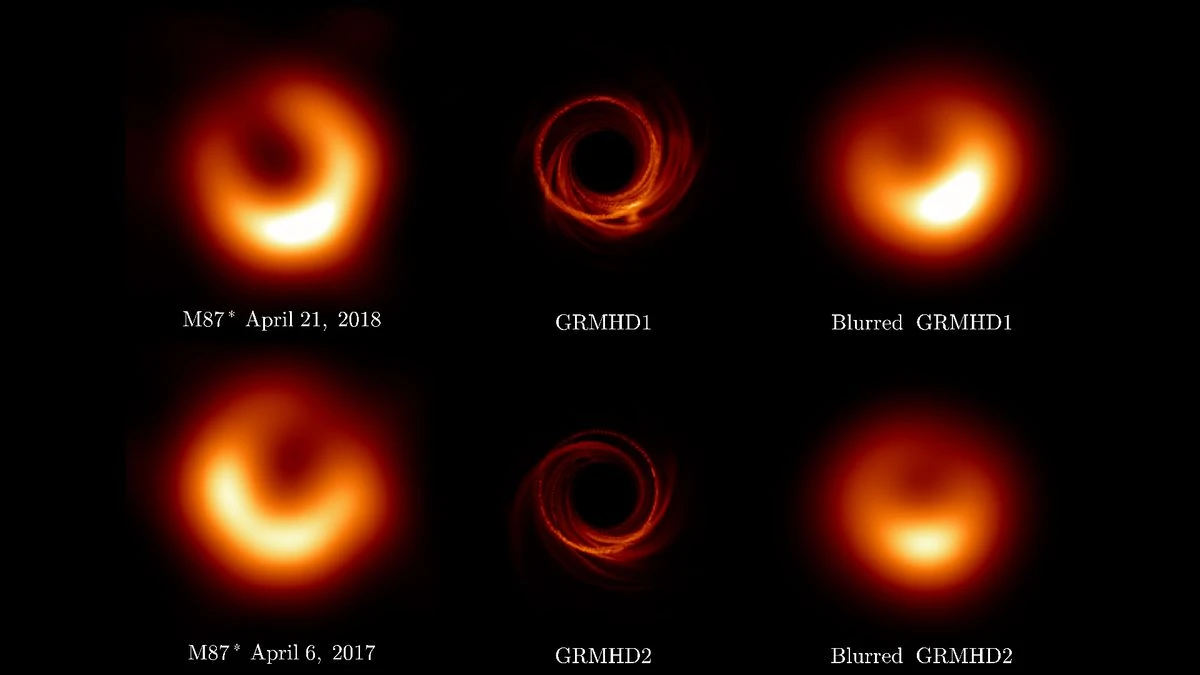
Conformal Weyl Dynamics and Black Hole Stability: New Insights into Quasinormal Modes
- 👤 Speaker: Dr Nader Haddad | Cambridge University
- 📅 Date & Time: Tuesday 06 January 2026, 16:30 - 17:30
- 📍 Venue: Astrophysics New Small Meeting Room, Cavendish Laboratory
Abstract
Understanding the stability of rotating black holes and the structure of their quasinormal mode spectra is central to gravitational wave physics and strong-field tests of general relativity. In this talk, I present a novel theoretical framework that reformulates black hole perturbation theory through the conformal properties of the Weyl tensor. By constructing a new conformal invariant from the electric and magnetic components of the Weyl tensor, I introduce a conformal stability functional whose sign provides a necessary and sufficient criterion for mode stability. This approach leads to a unified master equation that naturally connects and extends the Regge–Wheeler–Zerilli and Teukolsky formalisms. Two fundamental results follow: a conformal stability theorem linking black hole stability to the definiteness of the invariant functional, and an isospectrality theorem for conformally related black hole spacetimes. Applying the formalism to Schwarzschild, Kerr, and Kerr–Newman geometries, I demonstrate analytically and numerically the emergence of previously unexplored branches in the quasinormal mode spectrum, with deviations reaching several percent in the near-extremal Kerr regime. I conclude by discussing the observational implications of these conformal corrections for gravitational wave ringdown signals and black hole shadow measurements, highlighting how future detectors and high-resolution imaging may provide empirical access to the conformal structure of spacetime in the strong-gravity regime.
Series This talk is part of the Conformal Weyl Dynamics and Black Hole Stability: New Insights into Quasinormal Modes series.
Included in Lists
- Astrophysics New Small Meeting Room, Cavendish Laboratory
- Conformal Weyl Dynamics and Black Hole Stability: New Insights into Quasinormal Modes
Note: Ex-directory lists are not shown.