![[Search]](/static/images/search.gif)
![[A-Z Index]](/static/images/az.gif)
![[Contact]](/static/images/contact.gif)
![[University of Cambridge]](/static/images/identifier2.gif)
![[Talks.cam]](/static/images/talkslogosmall.gif)

 Floriane Magera, EVS, University of Liege
 Thursday 29 January 2026, 15:00-16:00

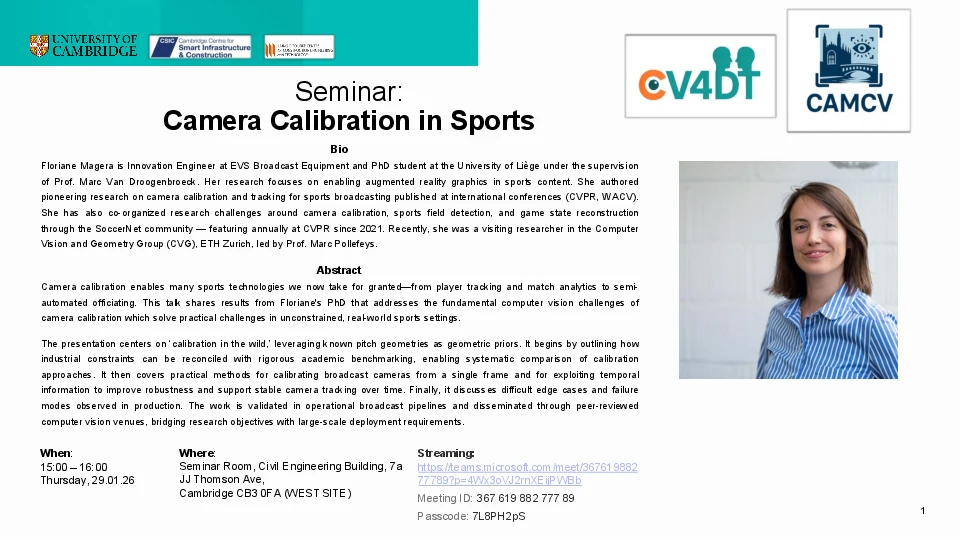
Camera Calibration in Sports, F. Magera, Seminar
- 👤 Speaker: Floriane Magera, EVS, University of Liege
- 📅 Date & Time: Thursday 29 January 2026, 15:00 - 16:00
- 📍 Venue: Hybrid, Seminar Room (1st floor), Civil Engineering Building, 7a JJ Thomson Ave, Cambridge CB3 0FA
Abstract
Dear CV Enthusiasts,
It is an immense pleasure to invite you to the seminar given by Floriane Magera on “Camera Calibration in Sports” (attached).
It is a hybrid seminar taking place in Seminar Room, Civil Engineering Building, 7a JJ Thomson Ave, Cambridge CB3 0FA (WEST SITE ) but also streamed online (see the flyer and below). Organised by CV4DT (https://cv4dt.github.io/) and new initiative – CAMCV (https://camcv.github.io/) – which is seeking new contributors.
See you at 15:00, Thursday, 29.01.26!
Feel free to share this invite and the attached flyer with your colleagues!
Bio
Floriane Magera is Innovation Engineer at EVS Broadcast Equipment and PhD student at the University of Liège under the supervision of Prof. Marc Van Droogenbroeck. Her research focuses on enabling augmented reality graphics in sports content. She authored pioneering research on camera calibration and tracking for sports broadcasting published at international conferences (CVPR, WACV ). She has also co-organized research challenges around camera calibration, sports field detection, and game state reconstruction through the SoccerNet community — featuring annually at CVPR since 2021. Recently, she was a visiting researcher in the Computer Vision and Geometry Group (CVG), ETH Zurich, led by Prof. Marc Pollefeys.
Abstract
Camera calibration enables many sports technologies we now take for granted—from player tracking and match analytics to semi-automated officiating. This talk shares results from Floriane’s PhD that addresses the fundamental computer vision challenges of camera calibration which solve practical challenges in unconstrained, real-world sports settings. The presentation centers on ‘calibration in the wild,’ leveraging known pitch geometries as geometric priors. It begins by outlining how industrial constraints can be reconciled with rigorous academic benchmarking, enabling systematic comparison of calibration approaches. It then covers practical methods for calibrating broadcast cameras from a single frame and for exploiting temporal information to improve robustness and support stable camera tracking over time. Finally, it discusses difficult edge cases and failure modes observed in production. The work is validated in operational broadcast pipelines and disseminated through peer-reviewed computer vision venues, bridging research objectives with large-scale deployment requirements.
Cheers,
Olaf
Microsoft Teams meeting Join: https://teams.microsoft.com/meet/36761988277789?p=4Wx3oVJ2rnXEijPWBb
Meeting ID: 367 619 882 777 89
Passcode: 7L8PH2pS
Series This talk is part of the Computer Vision Seminars series.
Included in Lists
Note: Ex-directory lists are not shown.