![[Search]](/static/images/search.gif)
![[A-Z Index]](/static/images/az.gif)
![[Contact]](/static/images/contact.gif)
![[University of Cambridge]](/static/images/identifier2.gif)
![[Talks.cam]](/static/images/talkslogosmall.gif)


 Thursday 06 March 2014, 13:10-14:00

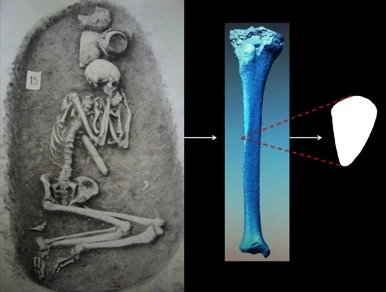
Tibial rigidity through prolonged culture change: Adaptation across ~6150 years of agriculture in Central Europe
- 👤 Speaker: Alison Macintosh, Division of Biological Anthropology, Department of Archaeology and Anthropology, University of Cambridge
- 📅 Date & Time: Thursday 06 March 2014, 13:10 - 14:00
- 📍 Venue: 1 Newnham Terrace, Darwin College
Abstract
As humans transitioned from hunting/gathering to farming, the associated changes in mobility altered the bending and twisting forces exerted on the lower limb bones. The tibia, or shinbone, adapts to these bending and twisting (torsional) forces during life by adding bone tissue where loads are highest and removing it where not necessary. Loading in the past can thus be reconstructed by quantifying these cross-sectional changes in bone distribution; across the shift to agriculture, mobility typically declines, particularly in men. After the shift to agriculture, intensive farming, the expansion of metallurgy and trade/exchange should continue to drive adaptation in tibial biomechanics. However, the effects of prolonged culture change on lower limb biomechanics in a single region have not been well characterized from a long-term temporal perspective, particularly in Central Europe, despite its rich agricultural history and archaeological assemblage. This study examines change in lower limb loading in Central Europe across ~6150 years from the initial spread of agriculture in the region (5300 BC to 850 AD). Bending/torsional rigidity along the length of the bone shaft was quantified from three-dimensional laser scans of 170 adult tibiae across four main time periods (Neolithic, Bronze Age, Iron Age, and Medieval). Results document high sexual division of labor in the earliest farming populations, with men performing the majority of tasks requiring long-distance terrestrial mobility and women doing a greater variety of tasks or fewer that required long-distance walking/running. Progressive temporal declines in male mobility despite the expansion of trade networks demonstrate the profound impact of mechanization and task specialization on lower limb bone biomechanics following the shift to agriculture.
Series This talk is part of the Darwin College Science Seminars series.
Included in Lists
- 1 Newnham Terrace, Darwin College
- All Talks (aka the CURE list)
- AUB_Cambridge Seminars
- Centre for Health Leadership and Enterprise
- Chris Davis' list
- custom
- Darwin College Research Talks
- Darwin College Science Seminars
- Darwin Lectures and Seminars
- Guy Emerson's list
- Interested Talks
- Neurons, Fake News, DNA and your iPhone: The Mathematics of Information
Note: Ex-directory lists are not shown.