![[Search]](/static/images/search.gif)
![[A-Z Index]](/static/images/az.gif)
![[Contact]](/static/images/contact.gif)
![[University of Cambridge]](/static/images/identifier2.gif)
![[Talks.cam]](/static/images/talkslogosmall.gif)

 Dr. David Sugden (qStandards) & Dr. Fernando Calero-Nieto (University of Cambridge)
 Thursday 05 March 2015, 19:00-22:00

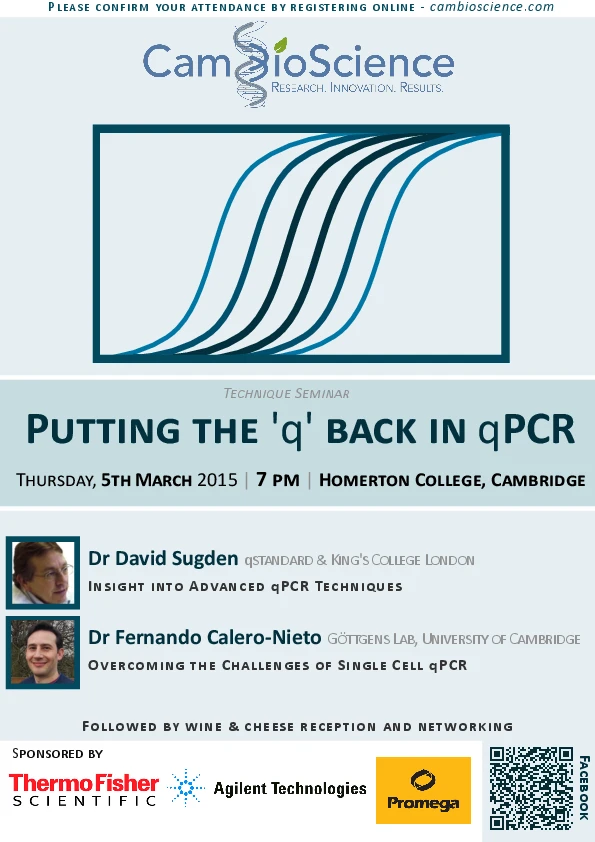
Putting the 'q' back in qPCR: State-of-the art advances in gene expression measurement
- 👤 Speaker: Dr. David Sugden (qStandards) & Dr. Fernando Calero-Nieto (University of Cambridge) 🔗 Website
- 📅 Date & Time: Thursday 05 March 2015, 19:00 - 22:00
- 📍 Venue: Horobin Room, Homerton College, Hills Road, Cambridge, CB2 8PH
Abstract
Since its inception the real time quantitative polymerase chain reaction, or more commonly ‘qPCR’, has become a fundamental and indispensable technique in almost every molecular biology laboratory. RT-qPCR has completely revolutionized what we know about the nature and regulation of our genes; however, many scientists in academia, industry and healthcare do not know how to make full use of its potential.
On Thursday 5th March at Homerton College Cambridge, we are hosting a state-of-the-art RT-qPCR seminar for users of this technique in both academia and industry; all levels are welcome!
Leading expert Dr David Sugden from qStandard and King’s College London will cover the common mistakes and challenges of RT-qPCR, such as those of standardization, as well as the inaccuracies and misinterpretations that have long been propagated in the wide-scale application of the technique. In addition, Dr Fernando Calero-Nieto, a senior scientist from the Göttgens lab at the University of Cambridge, will talk about the virtues and difficulties of single-cell RT-qPCR and the novel opportunities it has created in blood stem/progenitor cell research . The talks will be followed up with a networking session in which wine and food will be provided. There will also be an equipment and reagents showcase and a chance to interact with academic and industry specialists in this technique. We look forward to welcoming you!
Series This talk is part of the Molecular Techniques Seminars series.
Included in Lists
Note: Ex-directory lists are not shown.