![[Search]](/static/images/search.gif)
![[A-Z Index]](/static/images/az.gif)
![[Contact]](/static/images/contact.gif)
![[University of Cambridge]](/static/images/identifier2.gif)
![[Talks.cam]](/static/images/talkslogosmall.gif)


 Monday 02 February 2026, 17:30-19:00

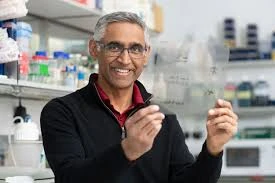
How Cells Make Membrane Proteins
- 👤 Speaker: Manu Hegde, MRC LMB Group Leader 🔗 Website
- 📅 Date & Time: Monday 02 February 2026, 17:30 - 19:00
- 📍 Venue: Department of Chemistry (Pfizer lecture theatre)
Abstract
Your genome encodes ~5000 proteins that are embedded in the membranes of your cells. Membrane-embedded proteins are the conduits through which information and materials are exchanged between the cell and its environment. Examples of membrane proteins include ion channels, hormone receptors, nutrient transporters, cell adhesion proteins, and many more. They control nearly everything – neurotransmission, immunity, sight, hearing, touch, digestion, taste, etc. – and problems in making them correctly underly diseases such as retinal degeneration and cystic fibrosis. Our research aims to provide a detailed molecular explanation for these complicated and diverse set of proteins get embedded into a membrane and folded into a functional product. I will discuss how we discovered the specialised machinery involved in membrane protein biogenesis, and our ongoing efforts to understand how this machinery works.
Short Biography: Ramanujan Hegde is a Programme Leader and Head of the Cell Biology Division at the MRC Laboratory of Molecular Biology (LMB), Cambridge. His research focuses on the maturation and quality control of newly made proteins in cells. Hegde completed his undergraduate studies at the University of Chicago and his MD and PhD at the University of California, San Francisco. He then led a research group at the US National Institutes of Health from 1999 to 2011, then moved to the LMB in Cambridge. Hegde’s work has been recognized by several honours, including his election as a member of the European Molecular Biology Organization, a Fellow of the Royal Society, and a Fellow at Trinity College, Cambridge.
Series This talk is part of the Cambridge University Biological Society series.
Included in Lists
Note: Ex-directory lists are not shown.