![[Search]](/static/images/search.gif)
![[A-Z Index]](/static/images/az.gif)
![[Contact]](/static/images/contact.gif)
![[University of Cambridge]](/static/images/identifier2.gif)
![[Talks.cam]](/static/images/talkslogosmall.gif)


 Wednesday 03 May 2006, 11:00-12:00

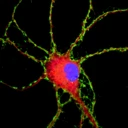
"Weak pairwise correlations imply strongly correlated network states in a neural population"
- 👤 Speaker:
- 📅 Date & Time: Wednesday 03 May 2006, 11:00 - 12:00
- 📍 Venue: Room 911, Rutherford Building, Cavendish Laboratory, Department of Physics
Questions? Contact
Oliver Stegle
Abstract
This paper combines our interest in computational neuroscience with our recent interest in Ising models. In contrast to the traditional Hopfield model the Ising approach is used here to make sense of real neural data taken primarily from the salamander retina. Perhaps surprisingly this simple pairwise model can account for most of the variability in the data and makes interesting predictions about the existence of a phase transition that could occur as the number of neurons increases above about 200.
http://www.nature.com/nature/journal/v440/n7087/full/nature04701.html
Series This talk is part of the Machine Learning Journal Club series.
Included in Lists
- Cambridge talks
- Guy Emerson's list
- Hanchen DaDaDash
- Inference Group Journal Clubs
- Inference Group Summary
- Interested Talks
- Machine Learning Journal Club
- Machine Learning Summary
- ML
- Quantum Matter Journal Club
- Room 911, Rutherford Building, Cavendish Laboratory, Department of Physics
- rp587
- TQS Journal Clubs
- yk373's list
Note: Ex-directory lists are not shown.